26 November 2005

Mummenschanz to tour Australia

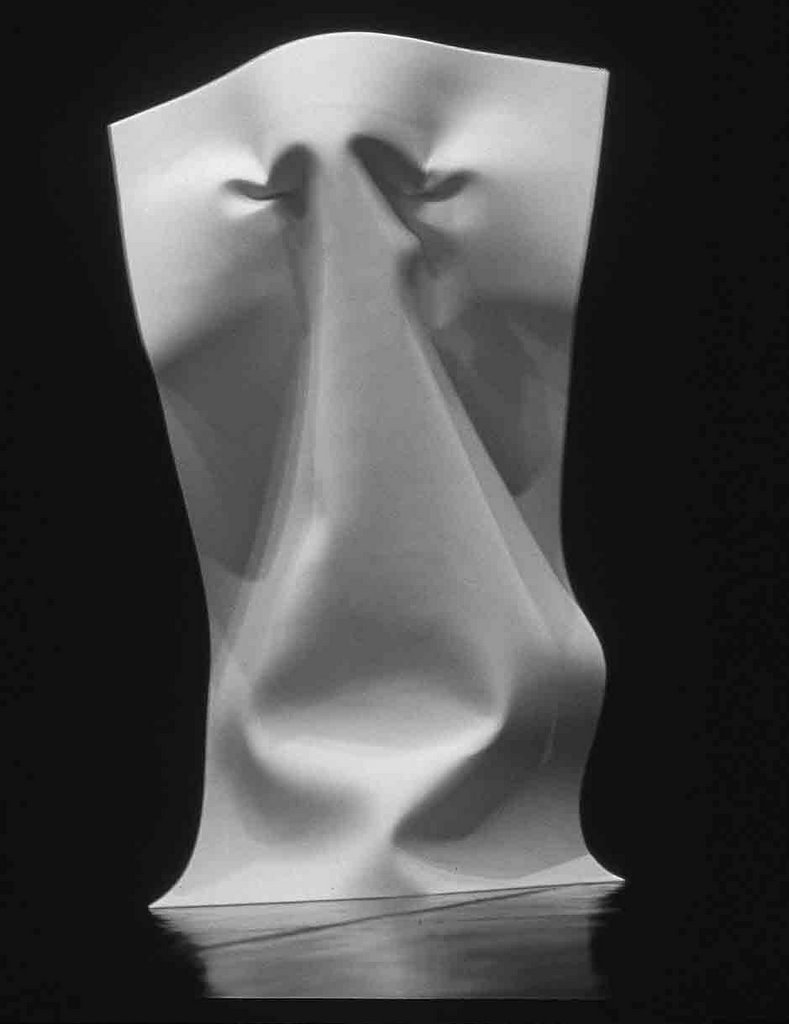
Swiss mime and object theatre legend, Mummenschanz will tour Australia and New Zealand beginning on 1 February 2006. Their tour is a restrospective of 33 years of their work and promises to be a treat for all Mummenschanz fans!
“With MUMMENSCHANZ we have invented a unique and most entertaining theatrical language through eloquent choreography of movement, rhythm and shape. It’s understood and enjoyed by people all over the world,” said co-creator Bernie Schurch. “We are overjoyed to bring our work to Australia, to share a new genre of theatre art that appeals to many generations”. For bookings, go to the Australian Ticketek's site!

25 November 2005

Puppetry in Israel

Israeli artistic director and puppeteer, Ilan Savir, who is producing my lecture and workshop tour in Israel, has recently done a series of great puppet television commercials for the Israeli Electric Company promoting electrical safety. They are available to check out on the net - the two oddballs, Sheka and Teka take a tongue in cheek look at some of the rich personalities that make up this diverse nation! Click here and here! (Also thanks to Puppet Vision!)

24 November 2005

Report on Silkeborg Festival, Denmark

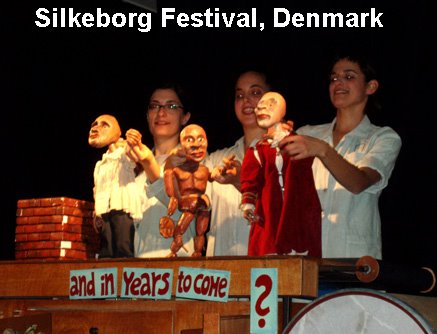
Finally, I've landed in Israel and catching up on the writing I've been wanting to do for so long. So here's that short report I promised to write on the recent Danish Festival of Wonder in Silkeborg. That's the Israeli company's Stumble Onto in the photo.

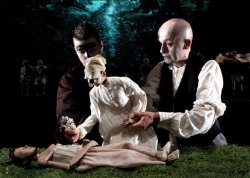
In Tranter’s dramatic one-man performance, Frankenstein, which officially opened the Festival of Wonder in Silkeborg, Denmark on 10 November, Tranter combines the strength of his acting and puppetry talents to portray the story of Mary Shelley through the eyes of some strange twisted characters, each competing for their place in the limelight. The deranged scientist Herr Frankenstein, is obsessed by his two creations, his young daughter and his monster, both whom he admits to experimenting upon. Tranter’s characters reflect a world of deranged evil contrasted only by the innocence of Frankenstein’s abused and imprisoned daughter, who informs him that she has fallen pregnant. When questioned as to whom the father is, she alludes to the puppeteer manipulating her!

Frankenstein admits to the commissar that in his quest for beauty and truth, he may have done things that narrow-mined people might not understand. But a man’s got to do, “what a man’s got to do!” retorts the evil commissar. The production combines Tranter’s one-man puppetry performance with two live musicians, on piano and marimba, as well as a full choir to assist in the final chorus ending this dramatic theatre piece.

To our delight many international groups graced the festival with their talent. ‘Stumble Onto’ is a production by the Daedalus and the Train Theatre from Israel. ‘The Laboratory of Human Curiosity’ reveals the magical and imaginative plots of a few human inventions, created purely by accident. At the beginning, in the Garden of Eden, fire is discovered. Then a glass, accidentally broken, is used to improve an old man’s sight and a hot-air balloon is used to get him airborne. Stumble onto is referred to as a dialogue between theatre and science, abstract and concrete form, which combine puppet shadows, objects and actors.
In Dorthe’s Heart, a Danish multi-media production for young children, two actors portray the uneasy relationship of finding first love. Using computer animation projected directly onto Dorthe’s body, we see her emotions, like the butterflies in her stomach, as she reacts to the passes of the boy down the road. Although visually interesting, a much wordy Danish dialogue made it difficult to understand! This multi-media theatre seems to be the new ‘thing’ in Europe, combining theatre, puppetry and image projection.

For me the highlight of the festival was discovering a young Danish puppeteer Sofie Krog. Her production of Diva 2 gave me fresh inspiration. Behind the heavy velvet curtains, we discover the talented singing ‘Diva’. Inside the theatre, we find the mad wheelchair-bound scientist, whose greatest ambition is to create a new body for his deformed self. The set consists of a multi-layered glove puppet stage, on wheels, which turns to reveal many smaller hidden stages on differing levels. The beauty of the show, combined with the simplicity of characters create a powerful visual treat. The scientist’s fear-ridden rabbit-assistant does all he can to locate the ingredients required to create the magical potent to make his transformation possible. But the plot in fact never turns out quite as expected, although the rabbit does find a mate in the process!

The Silkeborg Festival revealed some interesting new initiatives, especially in the Danish puppetry scene, which seems to be coming into its own with many new small companies producing work. Although these were mostly geared to a younger audience, there is still room for international collaboration and exposure, to combine talents and cultures to create something even more inspiring in Denmark.
(edited)

21 November 2005

Last night in Warsaw

Spent my last night in Poland with my old professor from Charleville days, historian, author, semiologist and dear friend, Dr Henryk Jurkowski and his wife Madga in Warsaw, catching up on old times. Then last night I got the plane to Israel (via London), where I arrived today. So here I am tonight, outside Jerusalem, staying with family and preparing for workshops and finishing the last few interviews for the documentary 'Looking for a Monster', all in the two weeks I'm here, before I continue to Barcelona. Tomorrow I'll catch up on my reports from the myriad of activities that I discovered in Europe...

17 November 2005

'Dead Puppet Talk' opens in Vienna tonight

New York puppet master Roman Paska's new production 'Dead Puppet Talk' opens at the Schauspielhaus in Vienna tonight! In his internationally successful and award winning productions he creates a counter universe of puzzling, mesmerizing images, where his puppets, as strange, but still related“ wiedergänger” of humans, yet beings of their own, explore and experience their existential situation in theatrical rituals, lightened by subtle humour. In 'Dead Puppet Talk' Paska condenses the questions of life and death, to be or not to be, with a text-intensive video film separated from the puppetplay, but yet linked via mutual echoes, while, through the refined mployment of the music, mixed live by Paul Prestipino to atmospheric soundscapes, he makes our perception of “living” and “dead” matter oscillate. The “Puppet-Walkers” move rhythmically with the sounds and seem likewise manipulated as the puppets, to whom they, allegedly, breath life. A fascinating piece of theatre art between dramatized philosophy and irony. Don't miss it!

Neville Tranter's Workshop at Silkeborg Festival

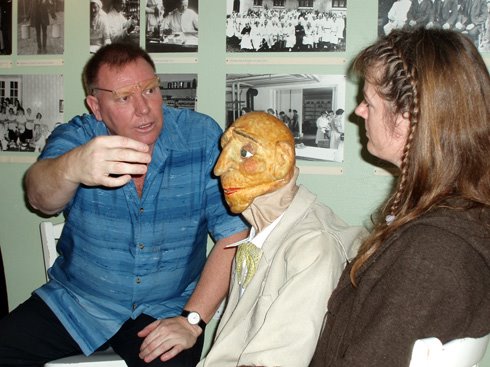
Fifteen participants, mainly Danish actors and teachers were involved in this two-day workshop last week at the Festival of Wonder in Silkeborg, Denmark. Neville Tranter, ex-Australian puppeteer, who has been resident in the Netherlands for the past twenty-five years, presented a workshop on his unique puppetry techniques. As a young person, Tranter was fascinated by Sesame Street and The Muppets, learning much of his technique of character presence in the television frame. The contact between the puppets and their audience held him and he adapted this technique to live theatre, viewing the world through the eyes of his puppet characters.

Tranter refers to the puppet as a mask that moves in the space and he wants us to understand how and why it works in the space and its effect on the audience. As a choreographer, he wants to find a minimal way of moving, which has a maximum effect upon his audience. He describes everything as a dialogue with the audience. It’s like playing ping-pong with the audience!


In the workshop, Tranter demonstrates the puppet’s articulation with a character he calls Zeno. Perched uncomfortably on his lap, like a ventriloquist dummy, Zeno’s piercing emotive eyes react to every move of the puppeteer. Each movement ends in a still pose, which the audience takes in. When the puppet moves, the actor must keep still, so as not to distract from its action. The eyes are always attracted to movement. When the puppet action ends, it can be continued by the actor, which gives a continuation and strength to its movement – a constant rhythm, like a dance.

An actor showing emotions in slow-motion may be melodramatic, but not so with the puppet. It can take its time to exaggerate an emotion and action. Tranter thinks in archetypes to tell a story. In his production of ‘Hitler’, he used the children of Goebels represent innocence, as a balance for dramatic work on different levels. He carefully chooses only the characters necessary to tell a story. He always uses one character to represent innocence, which plays off the other characters. It took him a long time to begin to play the role next to the puppet, which he couldn’t at first compete with, so he kept silent.

Everything he does with the puppet is very intimate and experienced close-up. The puppet’s character is always only an arms length from him, as he plays both actor and puppeteer and is extremely close-up. He likes to explore the relationship between the puppet and actor, which is dominant, and to fully explore all its possibilities. The same puppet can often take on different voices and characteristics, but movement is basic and often precedes the voice.

Breathing gives rhythm to the whole body and the movement and sound should correspond to its breathing. The students in the group are completely focused on the puppet, as each tries out some movement possibilities. The eye focus is demonstrated as the puppet head moves in direct line to an object, then holding a stillness and focus, keeping the emotion, and finally turning back to its original point of focus.

Tranter defines the movement as the constant pushing and pulling of the character by its environment. He demonstrates the double-take, where it reacts twice to a stimulus. When the puppet movement is continued after the sound of the breathe stops, it gives the puppet a stronger credibility that it’s actually breathing itself.

The puppet demonstrates an almost atavistic sense of natural movement, without over-intellectualising its character. When the puppet wants something, he is attracted towards it and thinks how he can achieve this. When it needs help, the puppet finds a way to attract the actor into assisting him. This we see in its body language, giving an intensity of expression that puppets do so well. We see the movement of the puppet sitting on the actor’s knee, when one character takes over the movement from another or copies a movement of the other, which takes on a dramatic or comic effect.

In his opening performance of 'Frankenstein' at the Festival of Wonder in Silkeborg, Denmark in November, Tranter aptly demonstrated all these devices and captured the dramatic moments so powerfully in the ambiguous relationship between love and hate, reflected by the way he portrayed the relationship between the old doctor and his abused imprisoned daughter. It’s the classic tale of the scientist who destroys himself through his own creation.

Watch out for Tranter’s new production of ‘Vampire’ which opens in the English version at The Schauspielhaus in Vienna in April 2006 (see www.schauspielhaus.at)
(Article edited)

15 November 2005

Back in the Polish Reality Sandwich

Back in Bielsko-Biala, Poland today, after an incredible Festival of Wonder in Silkeborg, Denmark. Here the internet is still being invented so the speeds are like dial-up. On Sunday I fly to Israel, where I will start my workshops and complete filming for our documentary 'Looking for a Monster', but will tell you more about it all next week. Also have a great report on the festival to post up then, so keep tuned!

11 November 2005

Festival of Wonder in Denmark

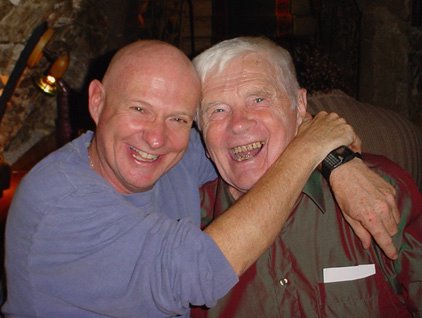
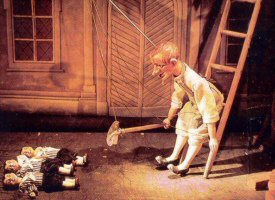
Here I am at this magnificent International Puppetry Festival in Silkeborg, Denmark. You can read all about the world-class performances on the Festival of Wonder website. The festival opened last night with a performance of Frankenstein by former-Australian, now Dutch puppeteer, Neville Tranter. He captivated his audience immediately with a blend of drama, live music and brilliant puppetry. I was also lucky enough to attend Neville Tranter's manipulation workshop yesterday, which gave a strong insight into his blend of puppetry and showed his strong technique in bring his characters to life through good construction, breath and immediate eye contact. Tonight we are seeing the Foreman Brothers (see the photo - left) from Prague, among others. I will try keep you updated more regularly, but unfortunately only when I can get internet access, which hasn't been that often of late!

2 November 2005

Bielsko-Biala, Poland

Humble apologies for the lack of postings recently. Europe seems so much more difficult to get decent internet access, compared to what I had in the United States and Canada. Today I just arrived by train in Bielsko-Biala and tomorrow start an intense four-day workshop in the city of Krakow in southern Poland. Thereafter it's off to the Silkeborg International Festival in Denmark. I will post some more detailed information on these exciting times very soon!